Kyrgyzstan's legislation stipulates that in order to obtain an academic degree, it is necessary to have publications in journals included in the List of Peer-Reviewed Scientific Periodicals of the Higher Attestation Commission. For scientists, publishing articles in Higher Attestation Commission publications is a key stage in their professional development and in promoting the results of their research. In this article, we will explain how to prepare a high-quality scientific publication and what to look for when choosing a suitable journal.
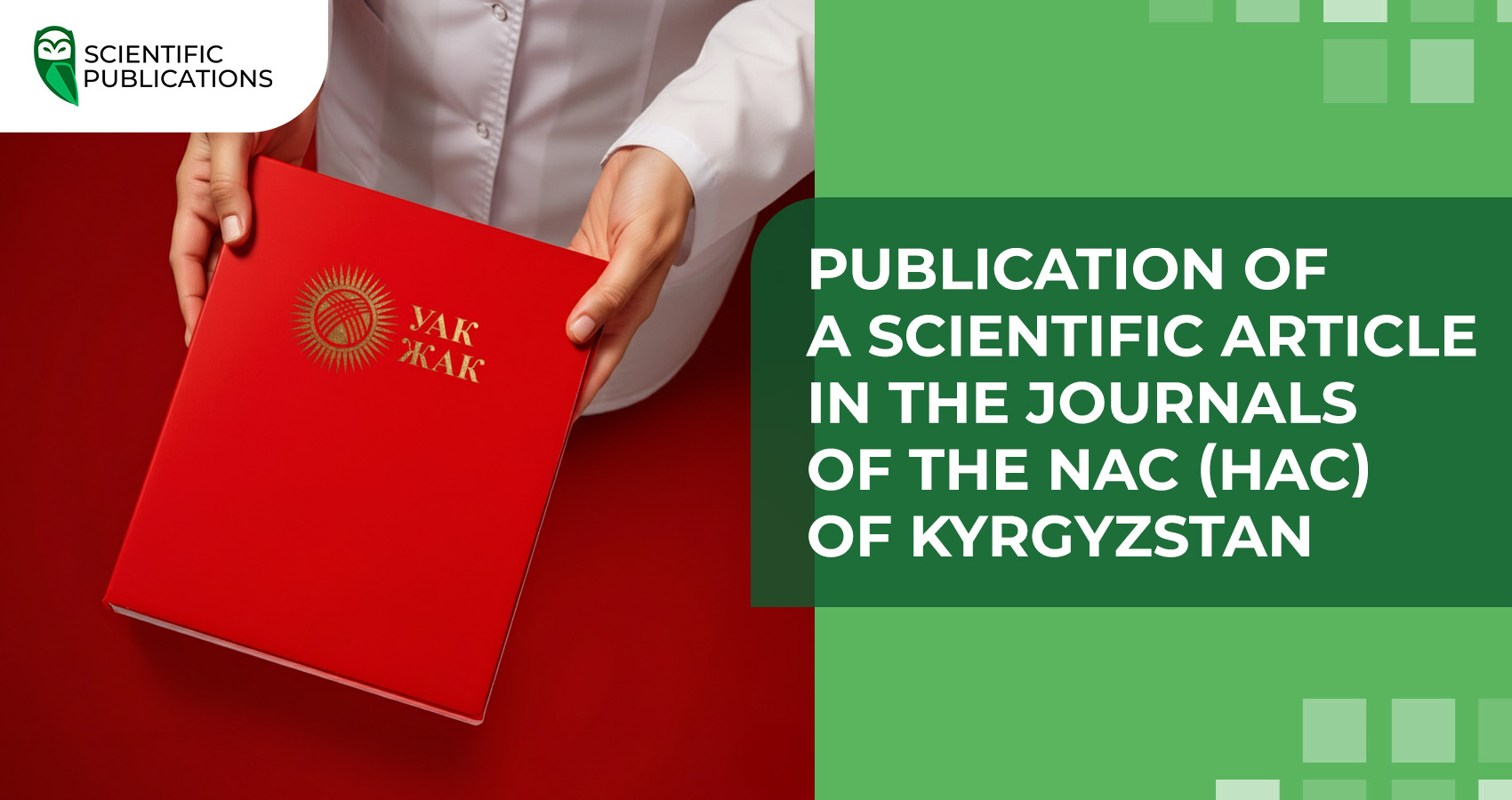
Higher Attestation Commission (HAC) of the Kyrgyz Republic
The Higher Attestation Commission (HAC) is a collegial state scientific and expert body responsible for regulating the attestation process for highly qualified scientific and scientific-pedagogical personnel.
Why do scientists need to publish in HAC journals?
One of the key requirements for scientists in the Kyrgyz Republic is to have publications in journals included in the HAC List. Such publications are intended for presenting the results of dissertations required for obtaining scientific degrees. Materials submitted to these journals must meet certain standards and undergo mandatory peer review.
Publication in journals included in the HAC's List is an important step towards achieving the main scientific goals of Kyrgyz scientists, in particular:
- obtaining a PhD degree
- obtaining a doctorate degree
- professional growth and new career opportunities
In addition, publishing articles in such publications helps scientists earn the necessary number of points to be admitted to defend their dissertations.
How to prepare a high-quality and successful scientific article?
1. Choosing a topic for a scientific article
The first step to successfully publishing a scientific article is to carefully and successfully choose and formulate a topic. This determines not only the interest in it from the scientific community, but also from journal editors and reviewers.
How to choose a topic for a scientific article?
- Relevance. The topic should reflect current trends in the relevant field of science. Current research is usually more likely to be published because it contributes to solving pressing problems, developing technologies, or updating approaches in a particular field.
- The researcher's interest and competence. It is equally important that the chosen topic is interesting to the author, as this provides motivation for in-depth study. Why is the author's competence important? It is necessary to have the required level of knowledge and skills to conduct research, write a well-founded study, and present the results.
- Scientific novelty. Many studies may have already been conducted and numerous scientific papers written on the chosen topic. It is important to identify and highlight new, previously unexplored aspects. A unique contribution significantly increases the value of an article.
- Target audience. It is necessary to determine who will be interested in your research: scientists of a certain specialisation, representatives of related fields, practitioners, or politicians. This will influence not only the choice of wording, but also the selection of a journal for publication.
- Practical significance. Especially in the applied sciences, it is important that the results of the research can be used in practice. This may be a solution to a specific problem, a proposal for a new technology, or recommendations for legislative changes.
- Access and scope of sources. Before you start researching and writing a scientific article, you need to make sure that you have sufficient sources and data. Make sure that you have access to this information.
A thoughtful and systematic approach to choosing the topic of a scientific article is the basis for high-quality work that will interest the right audience and the editorial board of the journal.
2. Structure and formatting of a scientific article
When preparing a scientific article, be sure to familiarise yourself with all the requirements for the structure and formatting of a scientific article. Most journals use the standard IMRAD structure, where:
- I – Introduction
- M – Methods
- R – Results
- A – and
- D – Discussion
It should be noted that some scientists believe that the letter “a” in the abbreviation stands for “and”. Others believe that the letter “a” stands for an additional section called “Analysis”. One reason for the existence of a section called “Analysis” may be that in some works, the “Results” section is not immediately understandable without an analysis of these results.
3. Research rationale
When writing a scientific article, it is important to rely on verified and relevant sources of information. Preference should be given to scientific works published within the last 3-5 years, as they best reflect the current state of the research topic. Choose publications that have been published in journals with a high level of trust and recognition among the scientific community. Avoid using unverified sources and questionable Internet resources, as this may affect the quality of your research.
4. Formatting references, citations, and the list of sources used
Be sure to pay attention to the requirements for formatting references and citations in the text of the article, as well as the list of sources used, which are established by the selected scientific publication. Detailed information can usually be found on the official website of the journal in the section for authors. These requirements are often presented in the form of text instructions or are available for download as separate documents. If the necessary information is not available, do not hesitate to contact the editorial office directly with a request to provide the current requirements for formatting the manuscript for further publication.
5. Formatting graphic material in a scientific article
Do not forget about the advisability of using graphic materials in scientific research – tables, graphs, diagrams, etc. They not only improve the visual perception of information, but also help to convey the results of the research clearly and concisely. At the same time, it is worth considering the specifics of their formatting. It is recommended to use graphic elements in formats that allow editing – this allows the editorial office to adapt them to the requirements of the publication (size, colour palette, etc.) during layout. If images or screenshots are added, pay attention to their quality: they should be clear, with the correct aspect ratio, without distortion or blurring.
6. Proofreading and editing the text
Pay special attention to the final stage of work on the article – proofreading and editing the text. Avoid grammatical, spelling and stylistic errors, as their presence may give the impression of inattention and carelessness in scientific work. Carefully reread the article several times, preferably with breaks, to increase the objectivity of your perception of the text. It will also be useful to involve a colleague or scientific supervisor – a “fresh look” will help identify shortcomings that you may have missed.
A successful scientific article is a combination of content, literacy, structure, and compliance with requirements.
Choosing a scientific journal: What to look for?
Choosing a publication is an important and responsible step, as you need to select the most suitable one from a huge number of journals. When choosing a scientific journal, you should pay attention to several key indicators.
How to choose a scientific journal from the HAC list?
- Regulatory requirements
- Availability of peer review
- Relevance of the subject matter
- Scientometrics indicators of the journal
- Publication deadlines
- Reliability of the journal
- Frequency of issues
- Publication policy
- Features of consideration by the editorial board and reviewers
Choosing the right scientific publication for your work is an important step in your research activities. It is crucial to evaluate all the necessary indicators and factors, as this will determine how your research will be promoted, disseminated and cited, as well as your authority and recognition, and the time it will take to get published.
Guaranteed publication in journals of the HAC of the Kyrgyz Republic
Thanks to cooperation with Scientific Publications, you get:
- Pre-publication consulting. Our experts will provide recommendations on developing and optimising the structure and content of your article in accordance with scientific and stylistic requirements.
- Assistance in selecting a journal. We will help you select scientific publications that correspond to your field of research and have high quality indicators, increasing the likelihood of your article being accepted.
- Editing and proofreading. Our editors will check and edit your article, including grammar, style, etc., to ensure that it meets the journal's requirements and looks professional.
- Article formatting. We will adapt your article in accordance with the journal's recommendations, including correct formatting, citation style, and the design of illustrations and additional documents.
- Support during peer review. We will help you respond to reviewers' comments, give advice on how to take their suggestions into account or justify why they cannot be accepted.
- Monitoring the publication process. Our team monitors the publication process, maintaining contact with the journal editors and informing you of the current status of the article.
- Article promotion. After publication, we will help you distribute your article in the scientific community to increase its visibility and impact on science.
Choose a reliable partner in scientific consulting – choose Scientific Publications! We work with scientists from more than 65 countries exclusively on the basis of an official contract. Fill out the form below or leave a request on the website, and our manager will contact you shortly. Together to successful publications and new heights!