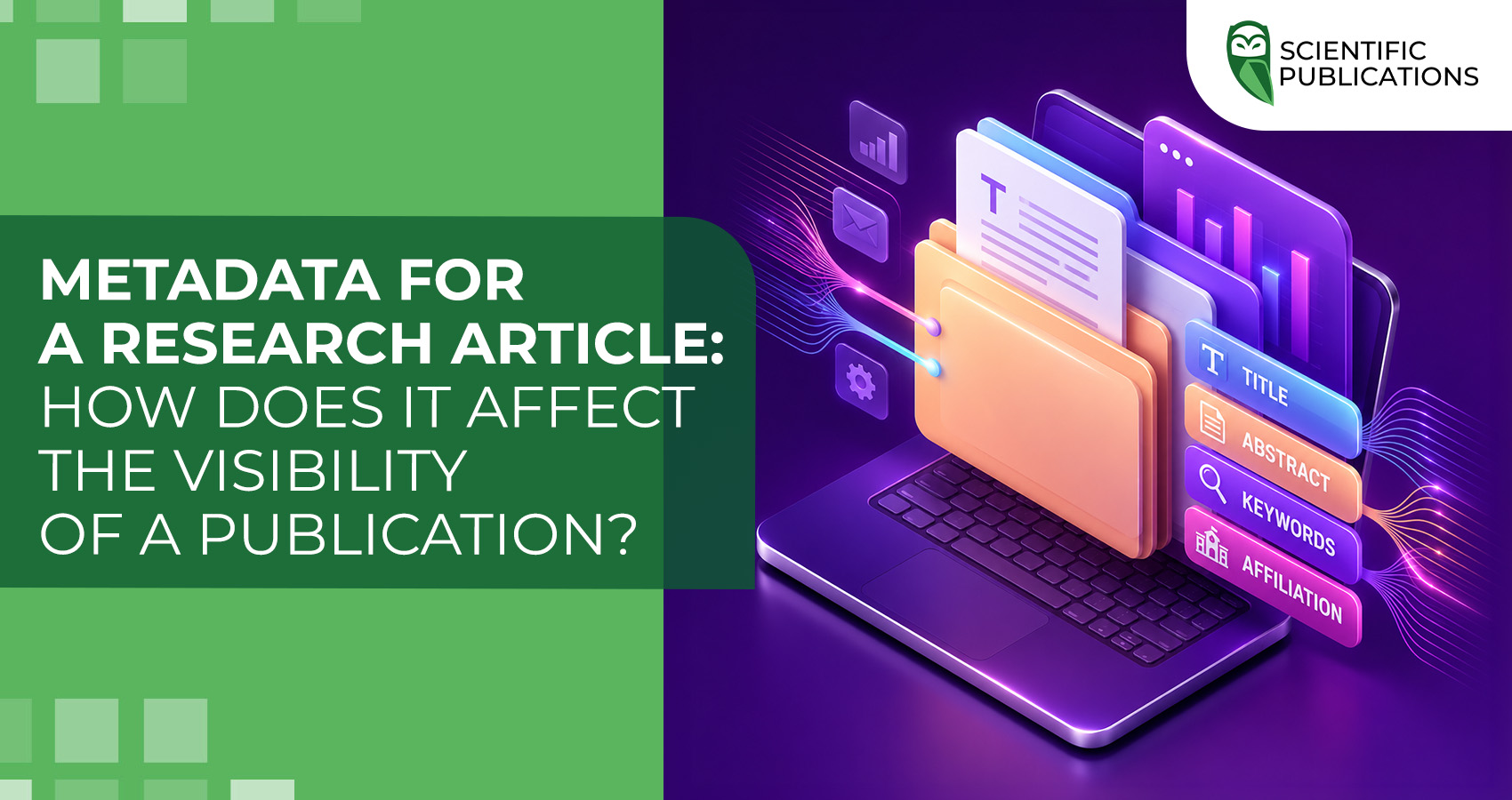
Preparing a scientific article's metadata – title, abstract, keywords and affiliation – has a direct bearing on whether it is found in Scopus, Web of Science and Google Scholar. Even a methodologically sound study risks going unnoticed if the title is vague or the keyword set is incomplete, whereas well-prepared metadata improves the chances of indexing and citation.
Why does metadata determine a scientific article's visibility?
Most academic databases analyse not the full text of an article but its metadata – the title, abstract, keywords and author details. Google Scholar's crawlers, along with the indexing algorithms used by Scopus and Web of Science, read these fields first. This matters most for articles with restricted access, where a reader judges relevance from the title and abstract rather than the full text. Metadata quality therefore affects an article's visibility as much as the substance of the research itself.
A title shapes the first impression of a paper's content
The title is the one element of a publication a reader sees before deciding whether to read further. Short, precise titles under roughly 90 characters tend to be cited more often than long, overloaded phrasing.
A title should include the key terms colleagues will search for, without turning into a list of every method and measure used: overly broad phrasing reduces the chance of appearing in a targeted search, while overly narrow phrasing limits the pool of potential readers.
How does the abstract affect an article's indexing and citation rate?
The abstract serves two purposes at once: it gives the reader a brief account of the work and, because it is indexed almost in full – unlike the title – it feeds search algorithms directly.
A common mistake is to confine the abstract to the background of the problem without setting out the aim, methods and results.
A few points are worth bearing in mind when drafting an abstract to improve its visibility:
- covering all the significant findings of the study, not just the introductory part
- using terms that match the article's keywords
- avoiding specialised abbreviations without spelling them out on first use
- stating the aim, methods and conclusions clearly
Keywords widen the reach of search queries
Keywords help citation databases match an article to relevant queries, which matters most when the full text sits behind a paywall. A common mistake is choosing keywords from the abstract alone, which drops terms that appear in the main body of the article.
When selecting keywords, it helps to follow this sequence:
- Review the keywords used in the most cited articles on a closely related topic.
- Use a subject-specific thesaurus where the journal provides one.
- Include both general disciplinary terms and narrower, specialised terminology.
- Check the chosen terms against the content of the whole article, not just the abstract.
A workable range is usually four to eight keywords: fewer narrows the reach of search queries, while more dilutes the publication's thematic focus.
Why does affiliation affect a publication's indexing?
Affiliation states the author's link to an academic or research organisation and works as a kind of scholarly citizenship. Using one consistent, correct organisation name across every publication is what allows an author's papers to be grouped correctly under their profile, rather than scattered among namesakes.
This matters particularly in Kyrgyzstan when preparing materials for attestation: the National Attestation Commission under the President of the Kyrgyz Republic and dissertation councils check an author's stated organisation against the university's official details.
A complete affiliation includes the organisation's official name, city, country and the author's ORCID identifier – this lets citation systems link an article to the right scholar's profile without error.
Title, abstract, keywords and affiliation form the minimum set of data by which an article is found, indexed and cited. Attention to each of these elements while preparing a manuscript reduces the risk that solid research goes unnoticed because of formal oversights in how it was presented.
Want your article's title, abstract and other metadata to work for its visibility and citation rate? The specialists at Scientific Publications"can help prepare your materials for publication and account for the requirements of the specific journal at every stage. Fill in the form below for a free consultation, and our manager will be in touch shortly. Onward to new academic achievements!