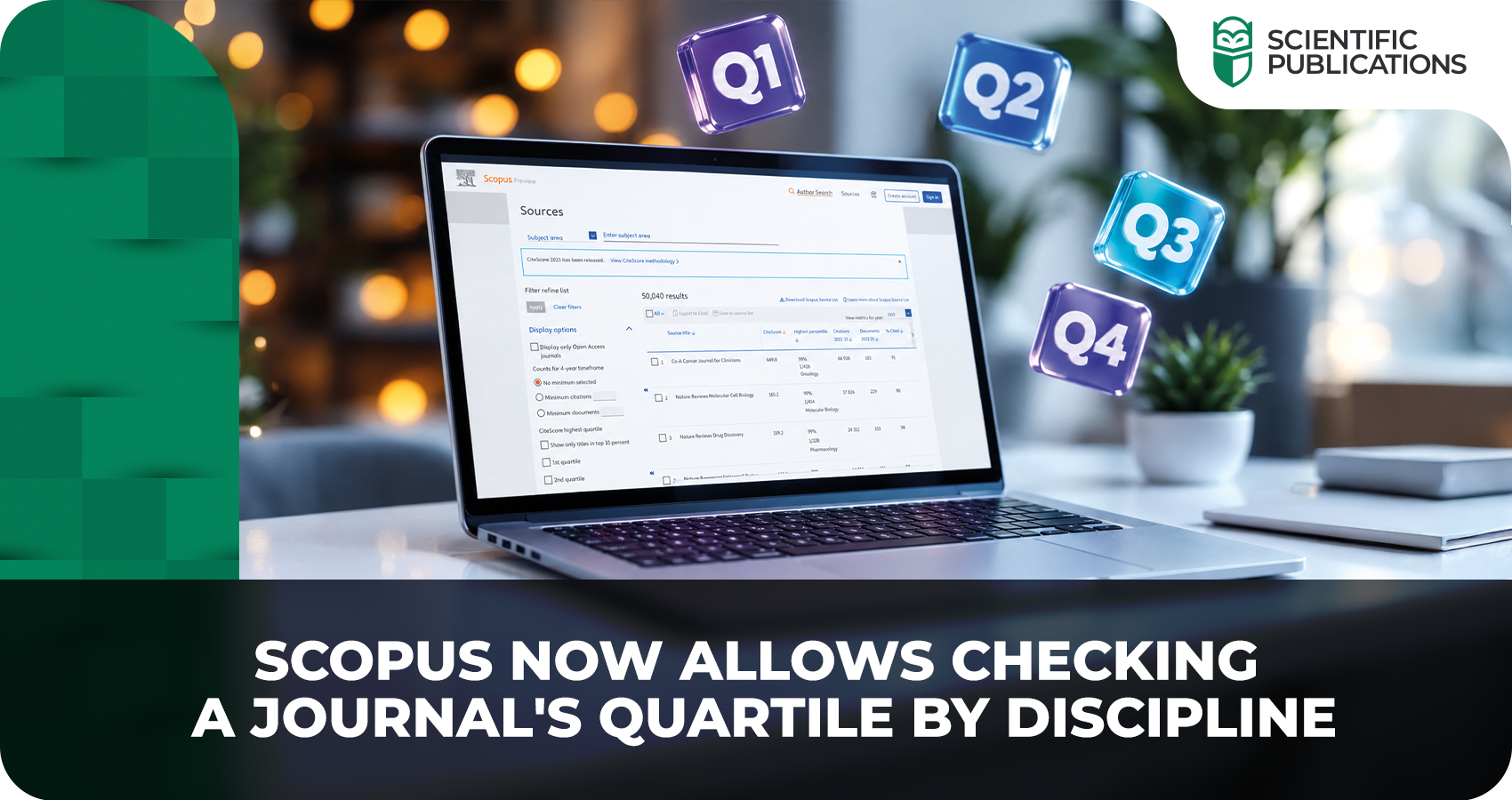
In Scopus, you can check a journal’s quartile for a specific subject area rather than relying on the journal’s best position. This helps scholars assess a journal in light of their own field of research. The same journal may have different quartiles in different subject areas, so it is useful to check the indicator against the field to which the article belongs.
What is a journal quartile in Scopus?
A journal’s quartile in Scopus shows which quarter of the ranking the journal falls into within its subject area.
The ranking is based on CiteScore, an indicator that reflects the average number of citations per publication in a journal over a four-year period.
The correspondence between percentile and quartile is as follows:
- first quartile (Q1) – percentile from 75 to 99
- second quartile (Q2) – from 50 to 74
- third quartile (Q3) – from 25 to 49
- fourth quartile (Q4) – from 0 to 24
Journals are ranked separately within each subject area, so comparing quartiles across different fields may be inappropriate.
A journal’s quartile in Scopus may differ by subject area
A journal may belong to several Scopus subject areas at once. In each of them it has its own CiteScore percentile and, consequently, its own quartile.
For example, a journal may be in the first quartile in one subject area and in the second in another.
In the list of sources on the Sources page, the subject area in which the journal ranks highest is usually the one shown. For a scholar working in another subject area, this quartile may not be relevant, so it is important to check the indicator in the field to which the article belongs.
How can you check a journal’s quartile in Scopus by subject area?
A journal’s quartile for the required subject area can be checked on the journal’s own page:
- Open the Sources section on the Scopus website.
- Enter the journal title or ISSN in the search bar.
- Go to the journal page and find the section with the CiteScore ranking (CiteScore rank).
- Find your subject area in the list and look at the journal’s percentile in it.
- Match the percentile to a quartile using the correspondence given above.
The journal page also shows how CiteScore has changed over the years, which helps to assess the stability of the journal’s position.
If you have not yet chosen a journal, you can specify a subject area on the Sources page and apply a quartile filter. As a result, a list of journals in the selected subject area will be displayed.
Access to Scopus may be provided through a university or a research organisation.
A journal’s quartile in Scopus and publication requirements in Kyrgyzstan
In Kyrgyzstan, the regulations for awarding Candidate of Sciences and Doctor of Sciences degrees provide for articles in journals indexed in Scopus and/or Web of Science. These requirements are set out in the document “Regulations on the Procedure for Awarding Academic Degrees”, posted on the website of the Higher Attestation Commission (HAC).
The document does not specify a particular quartile. Therefore, before choosing a journal, it is advisable to check the requirements of the university or dissertation council at which the defence is planned.
What should you pay attention to when checking a journal’s quartile in Scopus?
CiteScore indicators are published annually, so a journal’s quartile may change. When checking, it is advisable to rely on up-to-date data and to clarify which year’s quartile is taken into account in the requirements.
A Scopus quartile, an SJR quartile on the SCImago portal and a Web of Science quartile are calculated using different indicators. As a result, the values may not coincide for the same journal.
A quartile in itself does not show how suitable a journal is in terms of subject matter and editorial requirements. In addition, the list of journals in Scopus is updated periodically, so before submitting an article it is advisable to check that the journal is currently indexed.
Checking a journal’s quartile in Scopus by subject area makes it possible to assess a journal in the context of one’s own field of research, rather than by the journal’s overall position. Before submitting an article, it is advisable to compare the quartile with the journal’s scope, the requirements of the university and review times.
Planning a research article and need help with its publication? Specialists at Scientific Publications will help check the quartile and status of a journal, select a suitable one and support you at every stage of the publication process. To receive a free consultation, fill in the form below and our manager will contact you shortly. Onwards to new scientific achievements!