The Directory of Open Access Journals (DOAJ) is often called the ‘gold standard’ of open access to scholarly publications, and the inclusion of a journal in this database is considered an important indicator of its quality and reliability. However, in recent times, members of the academic community have developed doubts regarding its authority. Does DOAJ really guarantee high scientific quality? According to what principle does the database choose which journals to include and which to deprive of indexing? We will discuss this in more detail below.
What is DOAJ and what are its functions?
DOAJ – is an international online directory that indexes open access journals. It was founded in 2003 at Lund University in Sweden. The mission of DOAJ is to increase the visibility and accessibility of open access scholarly journals that publish materials free of charge for readers without subscription.
This platform sets itself several main tasks, in particular:
- Quality control. The database establishes basic standards for open access journals and checks them for compliance with the criteria of transparency, publication ethics, and editorial processes.
- Increasing visibility. Journals included in DOAJ become accessible through a centralised search interface, which makes them easier for researchers to discover.
- Combating predatory journals. DOAJ positions itself as a tool for protection against predatory journals – journals whose main aim is to profit from authors by providing low-quality publishing services (for example, placing an article for a fee without proper peer review or quality control).
- Support for open science. The database actively promotes the principles of Open Access, helping researchers to find journals where they can publish without access restrictions for readers.
Does DOAJ really adhere to its principles, or does it merely create the appearance of work?
Despite the fact that DOAJ positions itself as a tool for ensuring the quality and openness of scholarly publications, there are increasingly frequent discussions in the academic community about whether these duties have turned into a mere formality. Many researchers suspect that in practice the directory’s activities may contradict the declared principles of transparency, objectivity, and independence, creating the illusion of active work instead of real control over standards. Why does this happen? Let us look into it.
Lack of clear rules for removing journals
DOAJ is often criticised for the fact that the process of excluding publications does not have a single, well-documented procedure. When a journal loses its status in the database, publishers rarely receive a detailed justification. Instead of specific violations, such as data falsification or non-compliance with openness criteria, the directory restricts itself to general phrases such as “violation of indexing rules”.
This leads to authors and editors being left completely at a loss, not understanding how to rectify the situation or appeal the decision. Such uncertainty undermines trust in the entire system, because without standards, any decision looks subjective and unpredictable.
Suspicions of political pressure and external influences
Another aspect that raises doubts about the quality of DOAJ’s activities is that its decisions may be conditioned not only by scholarly criteria, but also by non-scholarly factors, including the political context. For example, journals affiliated with universities or institutes that criticise government policy or take part in reforms that contradict official narratives often face unfounded exclusions.
In addition, the difference in approaches to DOAJ’s work depending on the geographical factor deserves special attention. In some countries, the directory functions with full adherence to all rules and standards. However, in the course of our work we have repeatedly encountered situations in which DOAJ unjustifiably removes journals, ignores requests from publishers, and provides no feedback.
At the same time, it positions itself as a key platform for open science. For example, when submitting an application for the inclusion of a journal in the Scopus database, the editorial representatives have to indicate whether the publication is indexed in DOAJ. This fact underlines the significant influence of the directory in the academic environment.
Precisely because of such authority, any manifestations of inequality or bias become particularly unacceptable. They give rise to suspicions of geopolitical influence and create the impression that the directory is subject to external pressure, including from donors, partners, or even state bodies. This, in turn, calls into question its independence. Under such conditions, DOAJ risks turning into an instrument of censorship, where the scholarly value of research is pushed into the background.
Requirements to remove indexing in other databases
DOAJ often puts forward requirements to the editorial teams of scholarly journals to remove indexing in other databases. This becomes a kind of condition for inclusion in the directory, without which publications risk being refused.
Below you can see a letter from DOAJ that was sent to a scholarly journal. In it, representatives of the directory state that in order for the application for inclusion to be considered, the editorial office must remove indexing in the EuroPub and Index Copernicus databases.
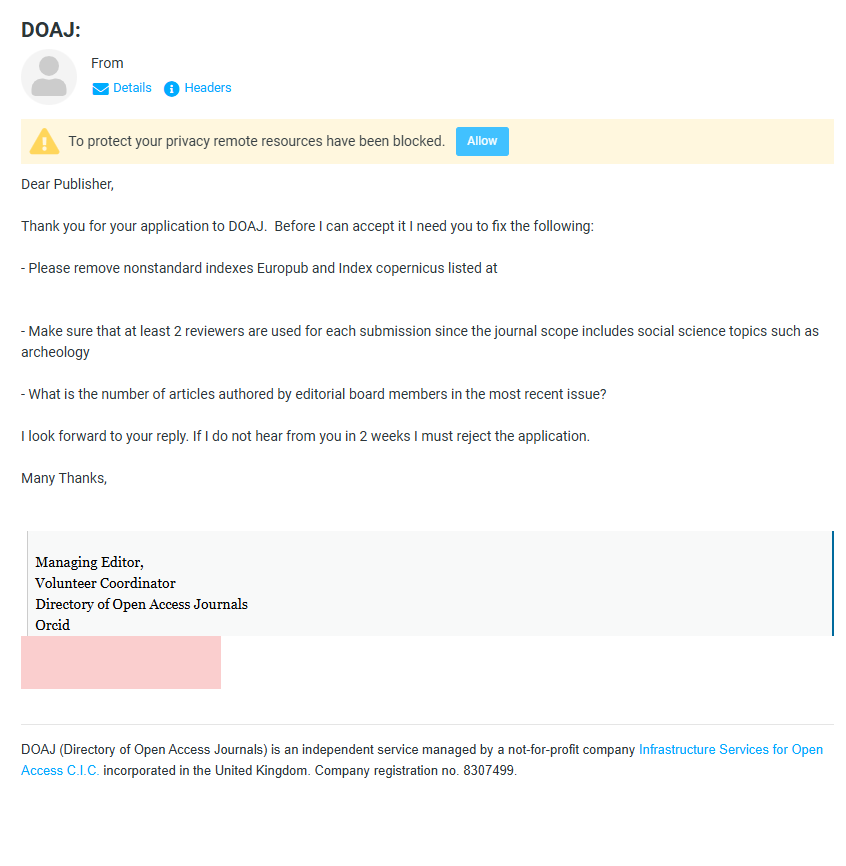
It follows from this that DOAJ may try to limit competition and create a circle of “recognised” platforms in order to monopolise the environment. Such rhetoric indicates a desire by the directory for non-transparent work and pressure on the editorial teams of scholarly journals.
Commercialisation of DOAJ
It is worth noting that the activities of the directory are funded thanks to contributions from donor-sponsors. However, given the presence of representatives of the organisation in many countries, logical questions arise regarding the volume and origin of these funds: who exactly finances their work on such a large scale? Unfortunately, it is not easy to find detailed information on sources of income, because DOAJ does not publish complete open reports in an accessible format.
Taking into account all the aspects mentioned, including dependence on external support, doubts inevitably arise: is such global activity of the directory really ensured exclusively at the expense of the declared donors, without hidden influences or additional sources?
Thus, despite the fact that DOAJ is considered the “gold standard” of open science, numerous gaps in its practices, from unfounded exclusions to suspicions of external influence, significantly undermine the trust of the academic community. This directory, which is intended to combat predatory publications and promote quality, risks turning into an instrument of monopoly and indirect control.